When shopping for a new kitchen hood, one question often stands out: what is the suction power of the kitchen hood? Many Malaysian homeowners tend to compare airflow numbers, assuming higher figures always indicate better performance. This is especially common when selecting kitchen appliances and hoods for a new home or renovation. While strong suction is indeed associated with more effective smoke and odour removal, it may not always tell the full story.
But is higher suction power always better? Does a high suction kitchen hood truly guarantee a cleaner, more comfortable kitchen, or is it sometimes just a marketing claim?
This article explores whether higher suction actually leads to better results and helps you understand how much suction power is truly needed for everyday cooking.
Key Takeaways:
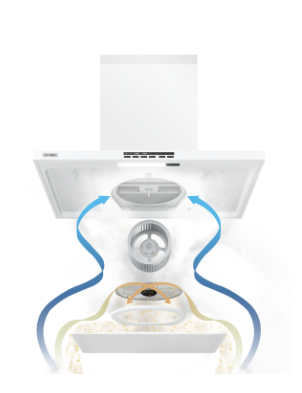
Marketing materials often highlight impressive airflow numbers as key selling points. Many brands promote high cubic metres per hour (m³/h) rating, which can create the impression that strong suction automatically delivers better performance.
As a result, many homeowners assume stronger suction always means more effective extraction, whether they are considering wall-mount hoods, island hoods, or compact models for small apartments.
There is also a common misconception that one suction level fits all kitchens. In reality, ventilation needs vary depending on kitchen size, layout and cooking habits. Simply choosing a range hood with the highest suction rating does not necessarily mean it will be the most suitable or efficient option for your space.
To make a smart choice, it is important to understand what kitchen hood suction power really means. In simple terms, suction power refers to the volume of air the motor can move within a certain period of time, usually measured in cubic metres per hour (m³/h).
Airflow ratings may be presented in different ways, most commonly based on IEC standards or unrestricted airflow. IEC airflow is measured using a standardized test setup that includes airflow resistance, providing a more realistic benchmark for comparing cooker hood performance. Because the test includes airflow resistance, the airflow values measured under IEC standards are usually lower but more realistic.
Unrestricted airflow measures how much air the motor can move without resistance from filters, ducting, or installation conditions, so these figures are usually higher than what you’d see in a real kitchen. However, high airflow alone doesn’t guarantee effective smoke capture, which also depends on overall hood engineering, filtration, placement, and the type of cooking (e.g., heavy frying versus light boiling). A well-engineered hood with a BLDC motor and optimised airflow management can outperform models that rely solely on higher unrestricted airflow figures, delivering more effective smoke extraction in everyday use.
Understanding how suction power is measured can help you make more accurate comparisons when evaluating different cooker hoods. Some brands present airflow using unrestricted measurements, while others follow IEC standards, which provide a more realistic benchmark for performance. However, suction power alone does not determine actual efficiency. Real-world performance is also influenced by factors such as installation height, ducting length, and the correct ducting diameter, all of which can significantly impact airflow and overall effectiveness.
Relying solely on suction power can be misleading. While strong airflow is valued, it is only one part of overall performance. Excessive suction can create drawbacks such as increased noise, higher energy consumption, and even reduce effectiveness if the hood installation is not optimised. If the airflow is too strong without proper installation, smoke may disperse before being channelled into the hood. This is why comparing a strong vs moderate suction hood requires looking beyond airflow figures.
Now that you know suction power isn’t everything, let’s look at the factors to consider when choosing a kitchen hood beyond high airflow. Selecting the right hood means balancing suction with design and performance:
A thoughtfully engineered kitchen hood with moderate suction can outperform a poorly designed model. When selecting a hood, factors such as hood size, airflow distribution, noise level, and energy efficiency are key to effective smoke and odour capture.
Many FUJIOH hoods, such as the FUJIOH FR-FD2490 VP feature a BLDC motor that delivers powerful yet energy-efficient and quieter smoke extraction. Other models, like the FUJIOH FR‑LW2490 V, is designed with a streamlined structure that optimises smoke and odour capture, helping maintain a clean and fresh kitchen.
High kitchen hood suction power alone does not guarantee better performance. It must be paired with good engineering. While airflow is important, overall efficiency depends on proper installation, capture area, filtration, and energy use.
A well-engineered hood can deliver excellent results with moderate range hood suction power, particularly when matched to your kitchen size and cooking habits. For smaller kitchens, a high-suction hood isn’t always necessary and may result in unnecessary energy use.
Instead of focusing solely on maximum numbers, homeowners should consider airflow design, technology, capture efficiency, filtration quality and energy use.
By understanding how much airflow you truly need and evaluating hoods based on practical performance rather than just numbers, you can choose a kitchen hood that keeps your cooking environment efficient, comfortable, and reliable for the long-term.
Q:What is suction power in a kitchen hood?
A: Suction power measures how much air a hood can extract, measured in m³/h. It indicates potential airflow, but real efficiency depends on hood design & technology, filters, and installation. FUJIOH hoods are engineered to balance powerful extraction with effective smoke capture.
Q:Does higher suction power always mean better performance?
A: No. Overall performance depends on airflow design, capture area, filter quality, and motor efficiency. A well‑engineered moderate‑suction hood often outperforms one that only emphasises high suction numbers.
Q:How much suction power do I really need for a gas hob?
A: Gas hobs typically require stronger airflow than induction or electric cooktops. For most kitchens, a range 700–1,200 m³/h (based on IEC standard), depending on kitchen size and cooking habits, is often suitable.
Q:Can too much suction be a problem in the kitchen?
A: Yes. Excessive suction can lead to higher noise levels, increased energy use, and create negative air pressure issues.
Q:How does suction power affect noise levels in a hood?
A: Yes, excessive suction can create problems in the kitchen. Very high airflow may increase noise levels, consume more energy, and cause negative air pressure that affects ventilation. It can also reduce effectiveness if the hood’s design and capture area aren’t optimised, as smoke and steam may disperse before being drawn into the hood.
Q:What are the differences between IEC standard airflow and unrestricted airflow?
A: IEC airflow is tested under standardised conditions that simulate real installation, including filters and ducting. Unrestricted airflow measures maximum output without filters or ducts, often resulting in higher, less realistic numbers. FUJIOH proudly provides transparent IEC ratings to give a realistic indication of real-world performance.
Q:Can high kitchen hood suction power improve odour removal instantly?
A: Not necessarily. Suction power primarily focuses on extracting smoke, steam, and airborne particles, not on eliminating odours..
